Professional Service
Boiler Spares SEO Case Study
How a technical parts supplier increased organic clicks by 18% without pretending the work was a magic ranking trick.
Boiler and heating spares SEO is not glamorous. That is exactly why it is valuable. Buyers search with model numbers, symptoms, compatibility questions and urgent replacement intent. The work was about helping the right pages catch that demand more consistently.
The short version
Steadier search demand capture for a specialist parts catalogue
A boiler spares supplier had useful products in a market with clear search demand, but the SEO opportunity was spread across hundreds of technical queries. The goal was not to chase one vanity keyword. It was to make the catalogue easier to understand, easier to crawl and more relevant to the searches buyers actually use.
The result was a practical lift in organic clicks and impressions over the comparison period, with a modest improvement in average position and CTR. That matters because technical ecommerce sites often win through cumulative long-tail gains rather than one headline ranking.
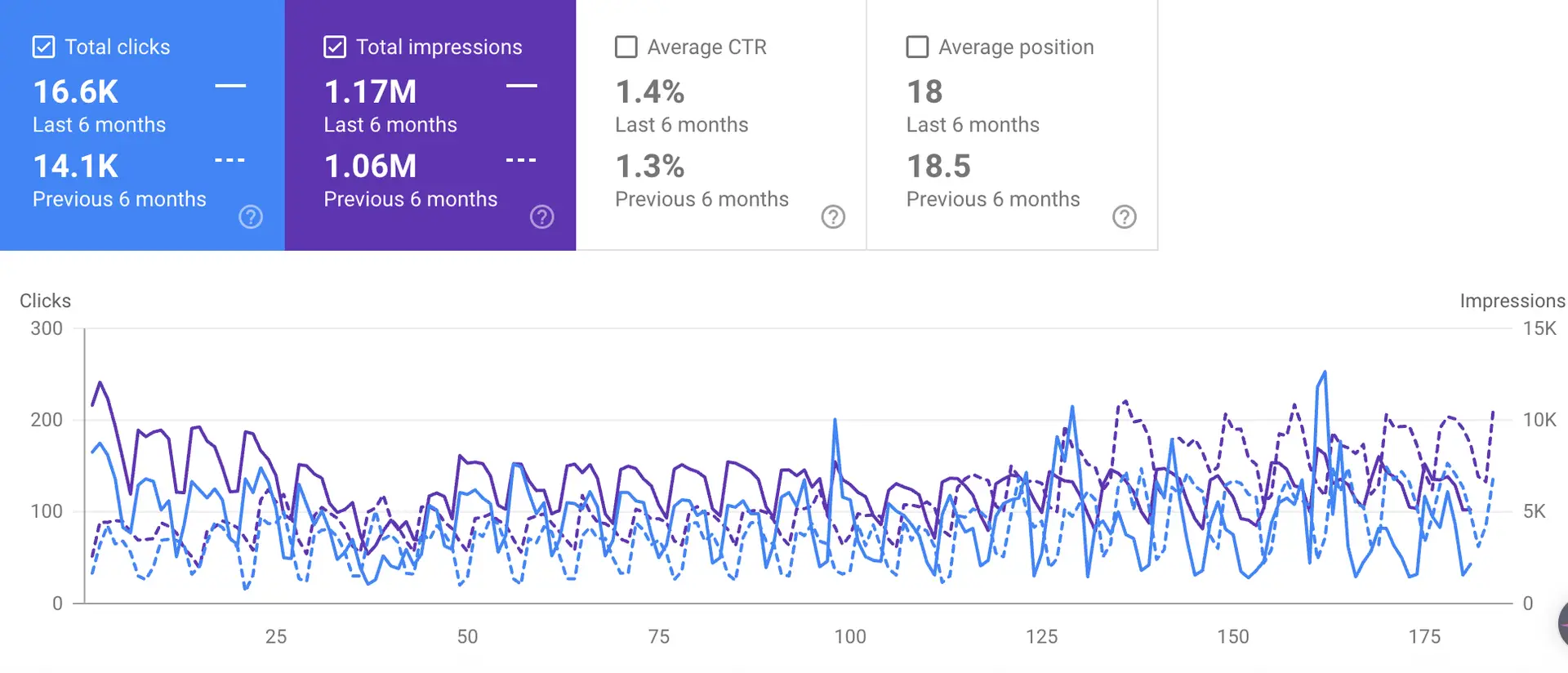
Search Console metrics used in this case study: 14.1k to 16.6k clicks, 1.06M to 1.17M impressions, average position 18.5 to 18.0 and CTR 1.3% to 1.4%.
Starting problem
The site needed clearer coverage across technical, high-intent searches
Boiler spare parts are searched for in messy ways. Some buyers know the exact part. Others search by boiler model, fault, compatibility or a category phrase. A useful SEO plan has to account for all of that without creating duplicate, thin or confusing pages.
The challenge was to improve visibility across a specialist catalogue while keeping the work grounded in commercial intent. Traffic was only useful if it brought people closer to finding the correct part or category.
Constraints
Why this was not a simple content campaign
Technical product language
Searches often include part names, boiler models and compatibility clues. Generic ecommerce copy would miss the point.
Large long-tail spread
The value was distributed across many searches, not concentrated in one obvious keyword.
Crawl attention mattered
Important categories and products had to be easier for search engines to find, prioritise and connect.
Proof had to stay honest
The average position moved only slightly, so the case study should explain the real win rather than exaggerate it.
What changed
The work focused on page relevance, catalogue structure and iteration from real data
For a specialist parts supplier, SEO needs to help search engines and buyers understand what each page is for. The workstreams below are the parts that mattered most.
Search demand mapping
We separated boiler model searches, spare-part names, compatibility queries and broader heating repair intent so the site was not treating every keyword like the same product search.
Category and product relevance
Priority pages needed clearer titles, headings, copy and internal links so search engines could understand which pages deserved to rank for specific parts and categories.
Crawl and architecture checks
Large ecommerce sites can bury useful pages. We reviewed how important categories, product groups and support pages were linked so crawl attention was not wasted.
Authority and trust signals
We supported the stronger page structure with relevant authority work, avoiding generic link activity that would not help specialist spare-part searches.
Monthly Search Console review
The campaign was adjusted from actual query, page and click data, not from a fixed list of SEO tasks that stayed the same for six months.
What moved
Organic clicks and visibility improved, with the caveat that average position only moved slightly
This is a stronger case study when it is read honestly. The site did not leap from page two to position one. It captured more demand across a technical catalogue and turned a broader set of impressions into more clicks.
Organic clicks +18%
Before14.1k
After16.6k
More visits from people already searching for boiler and heating spare parts.
Impressions +10%
Before1.06M
After1.17M
Broader visibility across product, category and long-tail spare-part searches.
Average position Small lift
Before18.5
After18.0
The commercial story was not a dramatic ranking jump. It was steadier coverage and better click capture.
CTR +0.1pp
Before1.3%
After1.4%
A modest snippet improvement matters when the site is already showing across more than a million impressions.
Commercial meaning
The win was better capture of existing buyer demand
For ecommerce spare parts, the commercial value is rarely about making people interested in boilers. They already have a need. SEO has to help the right category or product appear when that need becomes a search.
The +18% click lift suggests the site became better at collecting demand that already existed. The impression growth shows broader search coverage, while the small CTR lift suggests search snippets and relevance improved enough to convert slightly more visibility into traffic.
Lessons for similar businesses
What other technical ecommerce sites should take from this
Specialist ecommerce SEO is usually won through detail, not slogans. Model numbers, product naming, category clarity and compatibility language all matter.
A small average-position improvement can still produce useful growth when the site has large impression volume and better coverage across long-tail searches.
Clicks and impressions need context. The meaningful point here is steadier demand capture across a technical catalogue, not a miracle ranking graph.
Search Console should shape the next month of work. For parts suppliers, the data often reveals query variations that the catalogue structure has not caught yet.
Questions this case study should answer
Boiler spares SEO case study FAQs
Useful case studies should explain the conditions, limits and practical lessons behind the numbers.
What made this boiler spares SEO campaign difficult?
The site was competing in a technical ecommerce market where buyers search by boiler model, part name, compatibility issue and repair symptom. That creates a large long-tail SEO problem rather than one simple keyword target.
Were the results mainly from rankings or click-through improvements?
Both played a part, but the data shows a practical mix: impressions increased, clicks increased and CTR improved slightly. Average position only moved from 18.5 to 18.0, so the strongest story is broader and cleaner demand capture rather than one big ranking jump.
Why does a 0.1 percentage point CTR lift matter?
At more than one million impressions, even a small CTR improvement can create extra traffic. It is not a dramatic metric on its own, but it matters when paired with stronger visibility and better page targeting.
What SEO work matters most for spare parts ecommerce sites?
Category structure, product naming, compatibility content, internal linking, indexation control, schema and search snippet clarity usually matter more than publishing generic blog content.
Can this approach work for other technical ecommerce catalogues?
Yes, when the catalogue has real search demand and the business can support useful product, category and compatibility information. The exact plan should still start with a crawl, Search Console review and keyword mapping.
Does Bright Forge guarantee the same growth for other ecommerce sites?
No. Results depend on the market, technical condition, competition, catalogue quality and available resources. We use case studies to show the kind of diagnostic work and commercial thinking involved, not to promise identical numbers.
Want this kind of review for your site?
We can inspect the pages, queries and technical signals that are limiting organic growth.
If your ecommerce site has real demand but uneven organic performance, start with a focused SEO review. We will look at Search Console data, page structure, indexation and where the catalogue is leaking opportunity.
Let's Talk
Ready to Grow Your Business?
Get a free SEO consultation and discover how we can improve rankings, visibility and the path from search traffic to enquiries. Our team will respond within 24 hours.